
Core Strength for Beginners: Beyond Crunches
MBM (Mind Body Motion) Physiotherapy · 24 May 2026 · 3 min read
The core is a cylinder, not a six-pack
Crunches have monopolised the word core for so long that most beginners think it means the strip of muscle at the front of the belly. Anatomically, the core is a cylinder: deep abdominal layers wrapping the trunk like a natural weight-belt, back muscles running the spine like rigging, the diaphragm forming the lid and the pelvic floor the base. Its real job is not producing movement but preventing unwanted movement — holding the trunk steady while arms carry buckets, legs climb stairs and the spine absorbs a bus ride's jolts. Training that job looks very different from crunching, and suits beginners far better.
Why endurance beats strength for a beginner core
The trunk muscles that protect a spine work in long, low-intensity shifts — holding you upright through a ten-hour workday — so what they need first is endurance, the ability to keep working without fading, rather than one-repetition power. Research on spine loading has long favoured exactly this: moderate holds, repeated often, build protective endurance while keeping disc loads modest, whereas repeated loaded flexion is the pattern discs enjoy least. Hence the programme below: four exercises, all holds or slow controlled moves, all doable on a bedroom floor mat in ten minutes.
Exercise one: learning to brace without holding your breath
Lie on your back, knees bent, feet flat. Tighten your stomach gently as if preparing for a friendly poke — roughly thirty percent effort, the waist stiffening without sucking in or pushing out — and keep breathing normally throughout, five to ten seconds per hold, ten repetitions. This bracing is the ignition key for everything that follows, and the breathing is the test: if you cannot talk during the hold, you are gripping too hard. Practise until you can switch it on while standing in a queue. It should feel like quiet, firm tension all around the waist, never pain, pulsing or bearing-down pressure.
Exercises two and three: dead bug and bird-dog
The dead bug: on your back, arms pointing at the ceiling, hips and knees bent to ninety degrees. Brace, then slowly lower one arm overhead and the opposite heel towards the floor without letting the lower back arch away from the mat, return, and alternate — two to three sets of six to eight per side. The bird-dog mirrors it face-down: from hands and knees, extend opposite arm and leg to horizontal, hold five to ten seconds, alternate for the same sets. Both teach the cylinder to stay rigid while limbs move, which is precisely what carrying, climbing and lifting demand. Work belongs in the trunk; back pain during either means shrink the movement or do single limbs only.
Exercise four: the plank family, scaled honestly
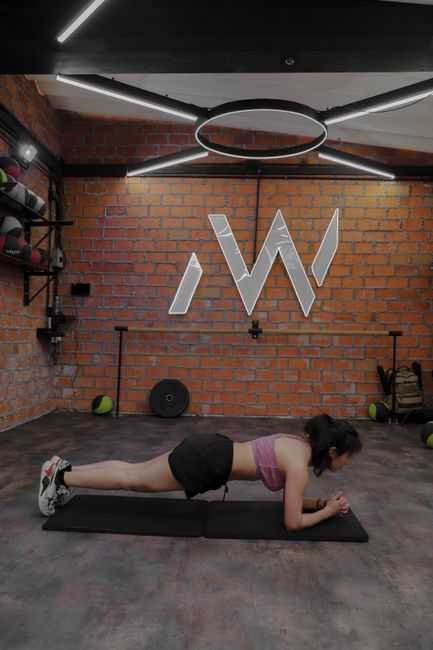
Planks are excellent and almost always started too hard. Begin against a wall or with hands on a table edge, body in one straight line from head to heels, braced and breathing — three to four holds of fifteen to twenty seconds. Progress over weeks to forearms on the floor with knees down, then full forearm planks, adding five seconds weekly toward thirty to forty-five seconds. A sagging waist or hoisted hips means the hold has outlasted your endurance — stop the clock there. Add side planks from the knees for the trunk's flanks, ten to twenty seconds per side. Shaking muscles are normal; wrist pain moves you to forearms, and shoulder pain means get the position checked.
A ten-minute week that actually progresses
Run the four exercises as a circuit — brace, dead bug, bird-dog, plank — three to four days a week, resting thirty to sixty seconds between exercises. Progress one variable at a time: a longer hold, an extra repetition, or a harder variation, never all three in one week. Within four to six weeks most beginners notice the practical dividends: steadier lifting, a back that survives long drives and wedding-season standing, better posture stamina at the desk. Plateaus respond to variety — slower tempos, a light weight on the dead bug — not to returning to hundred-crunch ambitions.
Who should modify, and when core work needs clearance
These beginner drills are gentle, but some situations need tailoring first. Anyone pregnant or within months of delivery should have the programme adapted — flat-on-back work and planks need modification, and a visible gap along the midline (doming when the head lifts) deserves professional guidance. A bulge or hernia at the navel or groin, recent abdominal surgery, or leaking urine during exertion all call for assessment before loading, the last because pelvic floor training must come first, and it is highly treatable. And core exercise during acute severe back pain, or pain running down a leg with numbness or weakness, is the wrong tool — get examined, settle the episode, then build the cylinder that helps prevent the next one.
Questions patients ask
Will these exercises give me visible abs?
Visible abdominal definition depends mostly on body-fat levels, which are governed by diet and overall activity. These exercises build the endurance and control that protect your spine — a different, more useful goal.
How long should I hold a plank as a beginner?
Start with fifteen to twenty seconds at an easy incline and add roughly five seconds a week with clean form. A steady thirty to forty-five second forearm plank is a strong practical benchmark; longer adds little.
Are sit-ups bad for the back?
Occasional sit-ups are fine for healthy backs, but high-repetition loaded flexion is the pattern spines tolerate least. Holds like planks and bird-dogs deliver more protection for less spinal cost, especially for beginners.
Suggested articles
Walking vs Running: What Each Really Does to Your Joints
Running is not automatically bad for knees, and walking is not automatically enough. What impact really does to cartilage, and how to choose.
18 August 2026 · 4 min read
Resistance Bands for Beginners: A Full-Body Routine in Twenty Minutes
One rubber band, eight movements, twenty minutes: a beginner's full-body strength routine with clear sets, reps and form checks for every move.
18 August 2026 · 4 min read
Gentle Sciatica Stretches for Seniors: Relief Without Strain
Chair-based, bed-based sciatica stretches designed for older bodies — gentle on hips and balance, precise about what each stretch should feel like.
17 August 2026 · 4 min read