
Strength Training After 40: Why Muscle Is Your Best Insurance
MBM (Mind Body Motion) Physiotherapy · 25 June 2026 · 3 min read

The quiet loss that starts in your forties
From roughly the fourth decade, adults who do not train lose muscle steadily — a slow leak of strength that goes unnoticed because life keeps adapting around it. The jar gets handed to someone else, the stairs get taken slower, the floor gets sat on less. The medical name is sarcopenia, and it matters because muscle is not just for lifting: it is the largest sink for blood sugar after meals, a guardian of bone density through the pull of tendons, and the difference between a stumble and a fall in your seventies. The encouraging part is that muscle responds to training at every age — the leak is optional.
Why resistance, not just walking, is required
Walking is excellent for the heart, but muscle grows only when it is challenged near its capacity, and an evening walk never approaches the capacity of your thighs. Muscle fibres adapt to the demand placed on them: ask them to produce genuinely hard effort — the last two repetitions feeling difficult — and they rebuild thicker and stronger over the following days. This is also how bone strengthens, since bone remodels along the lines of force that tendons transmit into it. No demand, no adaptation; that is the whole rule.
The five movements that cover ninety per cent of life
You do not need machines or complexity. Train a squat pattern (sit-to-stand from a chair, progressing to holding weight), a hinge (hip-led bending, the movement of lifting a bucket), a push (wall or floor push-ups), a pull (rowing a filled backpack or resistance band towards you), and a carry (walking with loaded shopping bags, chest tall). These five patterns strengthen every major muscle group and rehearse the exact demands of Indian household life — lifting cylinders, carrying water, climbing stairs, getting off the floor.
Start every movement with body weight alone for the first two weeks, learning the pattern before loading it. Form learned light stays with you under load; form learned heavy usually has to be unlearned later, sometimes by way of a physiotherapy appointment.
A twice-weekly starter plan that fits around work
Two sessions a week of thirty to forty minutes is enough to build strength for the first six months. Do two to three sets of eight to twelve repetitions of each of the five movements, choosing a load where the final two repetitions feel genuinely hard but your form stays clean. Rest sixty to ninety seconds between sets, and leave at least two days between sessions for the rebuilding to happen — the growth occurs during recovery, not during the workout. Add small load increases every one to two weeks; progress at fifty is measured in months, and it still comes reliably.
What normal soreness feels like — and what is a warning
Expect dull, spread-out muscle soreness peaking a day or two after early sessions, easing as weeks pass; that is the adaptation you paid for. Warning signs are different in character: sharp joint pain during a lift, pain localised to a tendon that worsens session on session, chest tightness, unusual breathlessness, or dizziness under load. Stop for any of those. Men and women over forty starting from sedentary, or anyone with heart disease, uncontrolled blood pressure or diabetes complications, should get a medical check before beginning — not because training is dangerous, but because starting right removes the risk.
Protein, sleep and the recovery side of the ledger
Muscle is built from dietary protein, and many Indian vegetarian diets sit lower on protein than the rebuilding process would like. Anchor each meal with a protein source — dal, paneer, curd, soya, eggs or chicken as your diet allows — rather than loading it all at dinner, because the body uses steady supply better than one flood. Sleep is the other half: growth hormone release and muscle repair concentrate in deep sleep, so chronic five-hour nights will quietly blunt your gains regardless of how well you train.
Making it stick past the enthusiastic first month
Attach sessions to fixed weekly slots and treat them like appointments — Tuesday and Friday before dinner outlasts "whenever I get time" by months. Keep a simple notebook of loads and repetitions, because visible progress is the strongest motivator in midlife training. Recruit a partner or family member; accountability roughly doubles adherence in our experience with patients. And when a week collapses, do one short session rather than zero — the habit, not any single workout, is the actual insurance policy.
Questions patients ask
Am I too old to build muscle at 55?
No. Muscle responds to progressive resistance training into the eighties and beyond. Gains come slower than at 25, but strength improvements of real, measurable size are typical within three months.
Will lifting weights damage my knees or back?
Sensibly progressed strength work protects joints — stronger muscles absorb load the joint would otherwise take. Injuries come from too much, too soon, with poor form, which a gradual plan avoids.
Do I need a gym membership?
Not for the first six months. A chair, a backpack loaded with books, water bottles and a resistance band cover all five movement patterns at home. Join a gym when home loads stop feeling hard.
Suggested articles
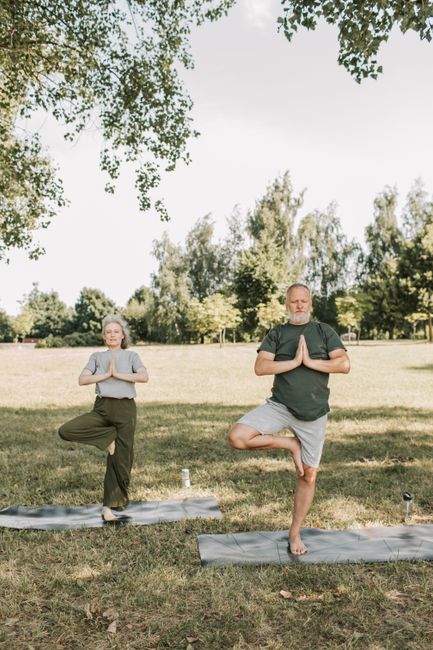
Balance Yoga for Seniors: Steadiness You Can Build at Any Age
Balance is trainable at any age. A supported yoga sequence for seniors — wall-side tree, mindful transfers, breath — that rebuilds steadiness.
20 August 2026 · 4 min read
Yoga With Knee Pain: Modifying Practice Instead of Quitting It
Knee pain rarely means quitting yoga. How to modify kneeling, deep bends and standing poses with props and angles so practice strengthens.
20 August 2026 · 4 min read
Chair Yoga at Your Desk: Ten Moves Nobody Will Notice
Ten discreet chair yoga moves — breath-linked stretches and holds you can do in an open-plan office without leaving your seat or drawing stares.
19 August 2026 · 4 min read