
Balance Yoga for Seniors: Steadiness You Can Build at Any Age
MBM (Mind Body Motion) Physiotherapy · 20 August 2026 · 4 min read
Steadiness is a skill, and skills retrain
Steadiness is a skill, not a fixed possession of the young. Balance runs on three information streams — the inner ear's motion sensors, vision, and position sense from feet and joints — blended by the brain and answered by quick muscle corrections. Age dims each stream a little, and years of avoiding wobbly situations dim them faster. The encouraging corollary is that they strengthen again when practised, at seventy as at seventeen.
Yoga suits this retraining unusually well: its poses hold the body at the edge of wobble long enough for the brain to practise correcting, and its slowness and attention to breath keep that edge calm and safe. What follows is a supported sequence — every pose begins with the wall or a chair, and graduating away from support is the progress, not the prerequisite.
Set up so a wobble costs nothing
Practise barefoot or in thin non-slip socks on a firm floor — thick soft mats muffle the foot's position sensors. Stand within reach of a wall on one side and a sturdy chair on the other, in a corner of the room clear of rugs, wires and pets, with a phone within reach. Practise when fresh rather than exhausted, and never immediately after blood-pressure tablets that make you light-headed on standing.
Two safety rules frame everything: touch support before you need it, and come out of poses slowly rather than toppling out. If you have had a fall in the past year, feel dizzy on standing, or have been told you have neuropathy in the feet, do this sequence only with someone nearby until a physiotherapist has watched you practise — supervision first is not a demotion, it is stage one.
Mountain pose: the balance pose nobody notices
Tadasana looks like standing still and is actually the foundation of every balance skill. Stand with feet hip-width apart and spread the toes, then rock gently forward and back a few centimetres, then side to side, shrinking the circles until you settle over the centre of your feet. Feel the tripod of contact — big toe mound, little toe mound, heel — and grow tall through the crown, shoulders soft, breathing slowly for five to eight breaths.
Practise this weight-mapping twice daily, perhaps while waiting for the kettle or the microwave. It sharpens the foot's position sense that shoes and inactivity dull, and it teaches the small ankle corrections that quietly prevent most stumbles.
Tree pose at the wall: the classic, made honest
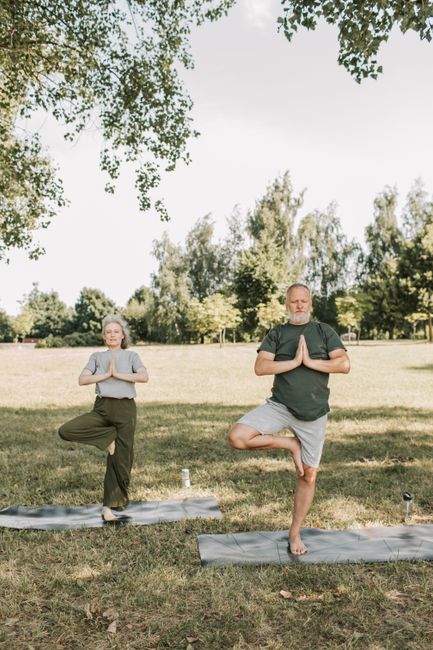
Stand side-on to the wall, fingertips resting on it. Shift your weight fully onto the wall-side leg, then place the other foot against the standing ankle with toes still touching the floor like a kickstand — this is the complete pose for week one. Hold five slow breaths per side, twice. Over weeks, the progressions run: foot to the calf, fingertip touch becoming a hover, gaze moving from a fixed point to slowly turning the head. The foot never presses against the knee joint itself — always above or below it.
You should feel the standing hip and ankle making constant small corrections; that busy trembling is the training working, not failing. Sharp hip pain, knee pain, or dizziness are stop signals. Anyone with a hip replacement should keep the lifted knee pointing more forward than sideways unless their surgeon has cleared full opening.
Chair-supported warrior and heel-to-toe walking
Warrior II with chair support builds the leg strength under balance: stand behind a sturdy chair, take a moderate stride sideways, turn one foot out and bend that knee over its ankle while hands rest on the chair back, holding three to five breaths per side. The front thigh should burn mildly while the trunk stays tall. Shorten the stance if the knee wobbles inward, and keep the bend shallow if kneecaps complain.
Then borrow yoga's moving meditation: heel-to-toe walking along a hallway wall, placing one foot directly in front of the other as if on a line, ten steps down and back with fingertips grazing the wall. Move at half normal speed, eyes ahead rather than on the feet. This tandem pattern rehearses the narrow base that real life demands at kerb edges, temple steps and bathroom thresholds.
Breath, gaze and the ten-minute daily structure
Fix your gaze on one unmoving point (a drishti) at eye level during every hold, because a steady visual anchor measurably steadies the body. Keep the breath slow and unheld throughout — four counts in, six out — since breath-holding stiffens the trunk and worsens sway, and a calm exhale is itself a balance tool.
A daily ten minutes might run: two minutes of mountain weight-mapping, tree pose both sides with the wall, chair warrior II both sides, hallway heel-to-toe walking, and a closing minute of seated breathing. Practise most days; balance circuits respond to frequency above intensity, and every graduation — calf instead of ankle, hover instead of touch — is a genuine achievement.
When wobbliness needs a doctor before a mat
Some unsteadiness is not a training problem. See a doctor promptly if balance has worsened suddenly, if dizziness spins (vertigo) rather than merely wobbles, or if unsteadiness comes with new headache, hearing change, numb feet, slurred speech or weakness — these need diagnosis, not tree pose. Medication reviews matter too, because sedatives, some blood-pressure drugs and combinations of several medicines are common, fixable causes of falls in later life, in India and the US alike. And after any fall with injury, or two or more falls in a year, ask for a proper falls assessment; yoga then becomes part of the prescription rather than a substitute for it.
Questions patients ask
Am I too old to start balance yoga at 75?
No — balance circuits retrain at any age, and supported poses make the practice safe from day one. Start with wall and chair versions, ideally with someone nearby for the first weeks, and progress by reducing support rather than by rushing harder poses.
How long until I notice steadier balance?
Most people who practise ten minutes daily notice steadier single-leg standing and more confident walking within four to six weeks. The nervous system keeps improving for months, so the habit is worth keeping permanently.
Is it normal to shake during tree pose?
Yes — trembling is the sight of your balance system making rapid corrections, which is precisely the training effect. It reduces as the circuits sharpen. Dizziness, spinning or pain are different signals and mean stop and reassess.
Suggested articles
Yoga With Knee Pain: Modifying Practice Instead of Quitting It
Knee pain rarely means quitting yoga. How to modify kneeling, deep bends and standing poses with props and angles so practice strengthens.
20 August 2026 · 4 min read
Chair Yoga at Your Desk: Ten Moves Nobody Will Notice
Ten discreet chair yoga moves — breath-linked stretches and holds you can do in an open-plan office without leaving your seat or drawing stares.
19 August 2026 · 4 min read
Yoga for Sciatica: Poses That Decompress and Poses That Provoke
Which yoga poses ease sciatic nerve pain, which reliably provoke it, and how to modify a practice so the nerve calms instead of flaring.
18 August 2026 · 4 min read