
Breathing for Recovery: How Slow Breath Speeds Healing
MBM (Mind Body Motion) Physiotherapy · 26 June 2026 · 3 min read

Watch anyone in pain and their breathing changes first
Shoulders creep up, the belly stiffens, and breaths become short sips into the upper chest — a pattern most people carry without noticing. This is the body's alarm system at work: pain and stress activate the sympathetic nervous system, which primes muscles to guard and keeps them mildly contracted around whatever hurts. Guarded muscles are poorly perfused muscles, and poorly perfused tissue heals slowly. Slow breathing is the most direct lever an ordinary person has on that alarm system, which is why we teach it in the clinic alongside exercises, not as an afterthought.
The mechanism: why the exhale calms the body
Your heart rate rises slightly on every inhale and falls on every exhale, driven by the vagus nerve — the main cable of the calming, parasympathetic system. Lengthening the exhale therefore biases the whole nervous system towards its rest-and-repair mode: heart rate steadies, blood pressure eases, stress hormones fall, and the resting tone in guarding muscles softens. None of this is mystical; it is measurable physiology, and it explains why five minutes of slow breathing can visibly loosen a clenched neck that stretching alone could not touch.
Technique one: belly breathing to unlearn the chest habit
Lie on your back with knees bent, one hand on the chest and one just below the navel. Breathe in slowly through the nose so that the lower hand rises while the chest hand stays almost still, then let the air leave without pushing. Practise for five minutes, once or twice daily. You should feel the lower ribs widening and the belly swelling gently; you should not feel the shoulders hitching upward. This retrains the diaphragm to do the work it was built for, which quietly unloads the overworked neck muscles that chest-breathers use all day.
Once the lying version feels easy, practise it sitting upright in a chair, and then standing, because the goal is a breathing pattern that survives daily life rather than one that only appears on a mat. Checking the two hands during a television advertisement break is practice enough to keep the habit alive.
Technique two: extended exhales for pain and tension
Once belly breathing feels natural, shape the rhythm: inhale for a count of four, exhale for a count of six to eight, with no strain at either end. Continue for five to ten minutes. This is the pattern we suggest during painful stretches, before sleep, and in the tense wait of hospital corridors, because the long exhale is where the vagal calming concentrates. If counting feels fussy, simply make each out-breath noticeably longer than the in-breath and let the numbers go.
Technique three: breathing during rehab exercises
Holding the breath while exercising is nearly universal and quietly harmful — it spikes blood pressure and stiffens the trunk, which is exactly wrong during stretching and risky for anyone with hypertension. The working rule: exhale during the effortful phase of a movement, inhale during the return. Rising from a chair, exhale as you stand; in a hamstring stretch, use each exhale to settle a little deeper. Pairing breath with movement also slows repetitions down, and slower repetitions are almost always better-quality repetitions.
Coaching a family member through this takes one minute and pays off twice over, since the habit of exhaling on effort protects them during lifting and household work too. Watch for the giveaway puffed cheeks and rigid chest of a breath-holder — most people genuinely have no idea they do it.
Breath, sleep and the healing that happens at night
Tissue repair concentrates during deep sleep, and pain is a notorious sleep thief — creating a loop where poor sleep lowers pain thresholds, which further wrecks sleep. Ten minutes of extended-exhale breathing in bed, lights off, gives many of our patients their first decent night in weeks, because it lowers the physiological arousal that pain keeps topped up. Keep the phone out of reach during this window; scrolling re-activates the very alertness the breathing just dismantled.
If the mind races despite the slow rhythm, count the exhales quietly from ten down to one and begin again whenever you lose the thread. The counting occupies the restless part of the mind while the lengthened breath does the physiological work underneath it.
What breathing cannot fix, and when to seek help
Slow breathing supports recovery; it does not replace diagnosis or treatment. Seek medical help promptly for breathlessness at rest, breathing difficulty with chest pain or tightness, wheezing, breathlessness that wakes you from sleep, or a racing heart that does not settle — none of these are problems to breathe through at home. Dizziness or tingling around the mouth during practice means you are over-breathing; return to a gentle, natural depth. Used within its lane, though, the breath is the one recovery tool you carry everywhere, free, for life.
Questions patients ask
How is this different from pranayama?
The techniques overlap deliberately — belly breathing resembles diaphragmatic pranayama and extended exhales echo classical ratios. We teach the versions with clear physiological rationale and keep them gentle, without breath retention for beginners.
How quickly does slow breathing reduce pain?
Muscle tension often softens within five to ten minutes of practice. The effect on pain itself builds with daily use over weeks, as sleep improves and overall guarding reduces.
Can I practise if I have asthma or COPD?
Yes — gentle nasal belly breathing is generally helpful, and pursed-lip exhales are a standard technique in lung conditions. Stay within comfort, keep your inhalers as prescribed, and stop if you feel air hunger.
Suggested articles
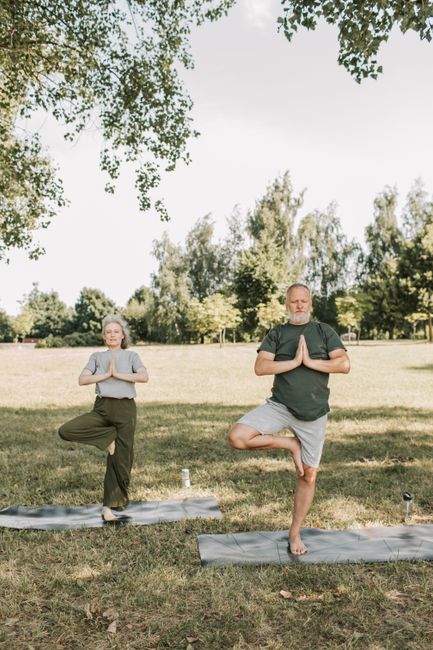
Balance Yoga for Seniors: Steadiness You Can Build at Any Age
Balance is trainable at any age. A supported yoga sequence for seniors — wall-side tree, mindful transfers, breath — that rebuilds steadiness.
20 August 2026 · 4 min read
Yoga With Knee Pain: Modifying Practice Instead of Quitting It
Knee pain rarely means quitting yoga. How to modify kneeling, deep bends and standing poses with props and angles so practice strengthens.
20 August 2026 · 4 min read
Chair Yoga at Your Desk: Ten Moves Nobody Will Notice
Ten discreet chair yoga moves — breath-linked stretches and holds you can do in an open-plan office without leaving your seat or drawing stares.
19 August 2026 · 4 min read