
Gentle Yoga for Joint Pain: Moving Without Aggravating
MBM (Mind Body Motion) Physiotherapy · 20 June 2026 · 3 min read
Why painful joints need motion, not rest
Cartilage has no blood supply of its own; it feeds by soaking up joint fluid, and that soaking happens when the joint moves and gently compresses. Rest a painful knee for weeks and the cartilage is fed less, the surrounding muscles waste, and the joint ends up less protected than before. Gentle yoga suits arthritic joints precisely because it moves them through range slowly, under body-weight loads you can regulate breath by breath, without impact. The aim is motion that nourishes, always short of provocation.
The two-hour rule: your personal safety gauge
Some discomfort during exercise is acceptable with arthritis — a stiff joint often grumbles as it warms. The reliable gauge is afterwards: if pain returns to its usual level within about two hours of finishing and the next morning is no worse, the session was appropriately dosed. If pain is clearly elevated the next day, the session was too much — shorten the holds, shallow the ranges, or drop the offending pose. This one rule lets you self-manage progress without a therapist beside you at every practice.
Keep a small diary for the first month — pose, holds, and how the joint felt next morning — because memory flattens these details and a diary exposes patterns within two weeks. Most patients discover that one or two specific poses drive their flares while everything else is comfortably safe.
Kind poses for painful knees
Practise a supported chair pose with your back sliding down a wall, bending only to a quarter-squat — thirty degrees or so — and holding for ten to twenty seconds, five repetitions. This strengthens the thigh muscles that shock-absorb for the knee, without deep bending. Add gentle seated knee extensions, straightening the leg slowly and holding five seconds. Avoid full squats, Vajrasana for long periods, and deep lunges while the knee is irritable; kneeling poses need a folded blanket under the joint, and even then keep them brief.
As the knee settles over the weeks, deepen the wall slide gradually towards a half-squat before adding anything new. Depth added slowly is strength the joint keeps; depth added in one ambitious week is usually returned with interest during the following one.
Kind poses for stiff, aching hips
A supported butterfly with cushions under both knees lets the hips open with zero forcing — two minutes of easy breathing there is worth more than thirty seconds of grimacing. Gentle hip circles on hands and knees, and a small supported bridge — feet hip-width, hips lifting a hand's height, held for three breaths — keep the joint gliding and the gluteal muscles awake. Avoid crossing into sharp groin pinching in any pose; that pinch is the joint itself objecting, not a muscle stretching, and pushing through it inflames rather than frees.
Hands, wrists and shoulders: small joints, small doses
For arthritic hands, slow open-and-close fists, gentle prayer-position wrist stretches held ten seconds, and finger spreads work better than any weight-bearing pose. Protect the wrists by working on fists or forearms in floor poses. Shoulders respond to slow arm circles, a gentle cow-face reach with a strap between the hands, and wall slides — arms sweeping up the wall as far as comfort allows. Small joints flare with smaller provocations, so begin with half the repetitions you think you can manage and let the two-hour rule guide the increase.
Props, warmth and timing: stacking the odds
Practise in the late morning or after a warm bath, when arthritic joints are naturally loosest — first thing after waking is usually the stiffest, crankiest window. A chair, a wall, two cushions and a strap turn most classical poses into accessible ones, and there is no prize for refusing them. In winter, warm the room and wear layers over the knees; cold joint tissue is measurably stiffer, which is why the same pose feels harder in January than in July.
None of this is cheating; it is dosing. Professional athletes rehabilitate with more supports and modifications than any yoga beginner will ever touch, precisely because grading the load correctly is what separates training from aggravation. Five minutes of warm water over stiff hands before a session earns its time back immediately.
When joint pain needs a doctor before a mat
Stop and seek medical review if a joint becomes hot, red and swollen, if pain wakes you nightly regardless of position, if a joint suddenly locks or gives way, or if you develop fever, unexplained weight loss or multiple joints flaring together — these patterns suggest infection or inflammatory arthritis, which need diagnosis and treatment, not stretching. After any fall with new joint pain, get checked before resuming. For stable, everyday osteoarthritis, though, a gentle daily practice is among the best-evidenced things you can do for your joints.
Questions patients ask
Can yoga cure arthritis?
No — nothing reverses established cartilage change. What gentle practice reliably does is reduce pain, improve stiffness and strengthen the muscles that protect the joint, which is what daily life actually feels.
Should I practise during a flare-up?
Scale down rather than stop: shorter sessions, smaller ranges, no held weight-bearing poses on the flaring joint. Gentle motion during a flare usually settles it faster than complete rest.
Is Vajrasana safe for knee arthritis?
Deep kneeling compresses the knee at its most bent angle, which many arthritic knees resent. Use a thick cushion between hips and heels, keep it under a minute, and skip it entirely if it flares pain.
Suggested articles
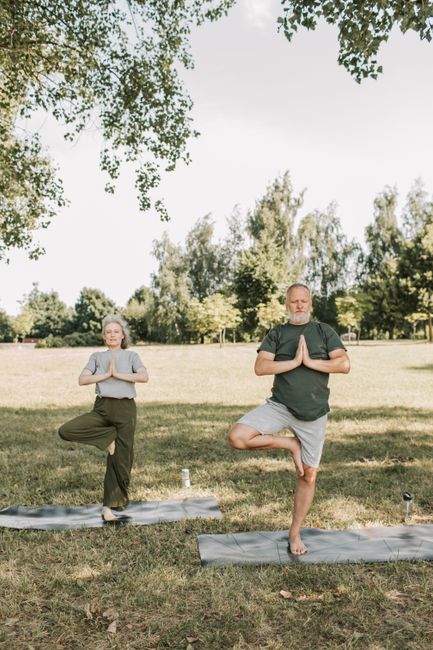
Balance Yoga for Seniors: Steadiness You Can Build at Any Age
Balance is trainable at any age. A supported yoga sequence for seniors — wall-side tree, mindful transfers, breath — that rebuilds steadiness.
20 August 2026 · 4 min read
Yoga With Knee Pain: Modifying Practice Instead of Quitting It
Knee pain rarely means quitting yoga. How to modify kneeling, deep bends and standing poses with props and angles so practice strengthens.
20 August 2026 · 4 min read
Chair Yoga at Your Desk: Ten Moves Nobody Will Notice
Ten discreet chair yoga moves — breath-linked stretches and holds you can do in an open-plan office without leaving your seat or drawing stares.
19 August 2026 · 4 min read